Industrial QR Code Tags: Which Materials Survive Harsh Environments?
 April 28, 2026
 Printed QR labels are the most common way facilities tag equipment — and the most common point of failure. UV, chemicals, abrasion, and temperature cycling destroy them in months. When the tag fails, the link to that asset’s documentation, history, and procedures goes with it.
This article compares the materials used for industrial QR code tags and explains which ones hold up in real operating conditions.
Why do printed QR labels fail in industrial environments?
Standard barcode and QR labels use thermal transfer or inkjet printing on polyester, polypropylene, or vinyl substrates. These work in warehouses and indoor settings. In industrial environments, they face conditions they weren’t designed for:
- UV radiation breaks down printed ink and adhesive binders. Outdoor labels can become unscannable within a single summer season.
- Temperature cycling — repeated expansion and contraction loosens adhesive bonds and causes substrate cracking. Equipment near process heat (boilers, steam lines, exhaust stacks) accelerates this.
- Chemical exposure — hydraulic fluid, caustic wash solutions, solvents, and acid mist attack adhesive layers and printed surfaces.
- Abrasion — vibration, foot traffic, and incidental tool contact wear surface-printed codes smooth.
- Moisture — rain, humidity, wash-downs, and freeze-thaw cycles work under adhesive edges, lifting tags from surfaces.
The result is the same: a blank or illegible tag on equipment that still needs to be identified, maintained, and documented.
What materials are used for industrial QR code tags?
Industrial QR tags generally fall into four categories, each with different durability profiles:
Polyester and vinyl labels
The most common and least expensive option. Flexible enough for curved surfaces (pipes, valves, gauges). UV-stabilized polyester labels with industrial adhesive can handle moderate conditions: temperature ranges of approximately -40°F to 300°F, basic moisture resistance, and limited chemical exposure.
Best for: Indoor equipment, curved surfaces, moderate environments where tags can be replaced periodically.
Limitations: Still a printed surface on an adhesive-backed substrate. The adhesive is usually the first failure point in harsh conditions.
Anodized aluminum
Aluminum tags with laser-marked QR codes offer better durability than labels. Black anodized aluminum (laser-ablated to reveal bare metal) provides good contrast for scanning. Some formulations are MIL-STD-810G tested for UV, abrasion, and temperature resistance.
Best for: General industrial use, indoor/outdoor where chemical exposure is limited.
Limitations: Standard aluminum is not suitable for chloride-rich environments (coastal, chemical processing). Anodized coatings can degrade under sustained chemical contact.
Acrylic and engineered plastic
Multi-layer acrylic tags (such as microsurfaced impact acrylic) allow laser engraving through colored layers for high-contrast QR codes. UV stable and outdoor-rated. Chemical resistance varies significantly by formulation — acrylic/styrene blends are vulnerable to solvents like acetone, toluene, and chlorinated compounds.
Best for: Control panels, indoor equipment housings, environments without aggressive chemical exposure.
Limitations: Temperature ceiling around 175–210°F depending on formulation. Not suitable for high-heat applications or heavy solvent environments.
316L stainless steel
Surgical and marine-grade stainless steel with laser-etched QR codes. The marking is a permanent surface change in the metal itself — not a coating, ink, or adhesive that can degrade independently.
- Temperature range: -40°F to 1500°F continuous service
- Chemical resistance: Withstands acids, alkalis, chlorides, and most industrial solvents. 316L’s molybdenum content provides specific resistance to pitting and crevice corrosion in chloride environments.
- UV: No degradation — metal does not respond to UV radiation.
- Abrasion: Surface hardness far exceeds any polymer or coating-based tag.
- Moisture: Fully impervious. No adhesive edges to lift.
Best for: Outdoor equipment, chemical processing, marine or coastal environments, high-temperature applications, any installation where the tag needs to last as long as the equipment.
Limitations: Rigid — not suitable for curved surfaces without mechanical mounting. Higher unit cost than labels or plastic tags.
How do you ensure a QR code scans reliably on metal?
Material durability is only useful if the QR code still scans. Three factors determine scan reliability on metal tags:
-
Contrast ratio. ISO 18004 specifies a minimum 4:1 contrast ratio between light and dark QR modules, with 4.5:1 recommended for field conditions. Laser-etched stainless achieves this through controlled surface oxidation that creates a dark matte pattern against lighter metal.
-
Matte finish. Reflective or polished metal surfaces cause glare that disrupts phone camera autofocus. Any metal QR tag must have a matte, brushed, or bead-blasted surface finish.
-
Error correction. QR codes support four error correction levels. Level H (the highest) tolerates up to 30% damage or contamination while remaining scannable — critical for tags exposed to dirt, grease, or minor surface damage over years of service.
Relevant standards for industrial QR tag durability
Several industry standards apply when specifying or evaluating QR tags for harsh environments:
Material and environmental testing:
- ASTM B117 — Salt spray (fog) testing. The standard corrosion test for metallic materials. Validates that a tag won’t pit, corrode, or become unscannable in marine, coastal, or chloride-rich environments.
- ASTM G154 / G155 — Accelerated UV weathering. Tests material degradation under concentrated ultraviolet exposure. Critical for any tag installed outdoors.
- ASTM D4060 — Taber abrasion resistance. Measures how well a tag surface holds up under physical wear — vibration, tool contact, grit.
- ASTM D3359 — Adhesion tape test. Grades adhesive bond strength (0B–5B) for tags that rely on adhesive mounting.
- UL 969 — The primary standard for marking and labeling systems. Tests adhesion, UV, temperature cycling, humidity, chemical resistance, abrasion, and legibility as a complete system. Most industrial procurement teams expect UL 969-rated label materials.
Mark quality and readability:
- ISO/IEC 29158 — Direct Part Mark (DPM) quality guideline. Specifically addresses quality verification for 2D codes that are laser-etched, dot-peened, or chemically etched directly into materials (as opposed to printed labels). This is the relevant standard for laser-marked metal QR tags.
- ISO/IEC 15415 — 2D barcode print quality grading (A through F). Defines how to measure and grade symbol contrast, modulation, and decodability.
Industry-specific identification requirements:
- API 574 / 570 / 510 — Oil and gas in-service inspection codes. Require permanent identification of Thickness Monitoring Locations (TMLs) and Condition Monitoring Locations (CMLs) on piping and pressure vessels.
- ASME BPVC Section VIII (UG-116) — Requires pressure vessel nameplates to be permanently attached and legible for the vessel’s service life in corrosion-resistant material.
- OSHA 29 CFR 1910.145 — Requires accident prevention tags to be weather and moisture resistant, not deteriorate in service conditions, and remain legible.
- NFPA 13 / 25 — Specifies “permanently marked weatherproof metal or rigid plastic” for fire protection equipment identification.
When evaluating any industrial QR tag, ask whether the manufacturer can point to specific test data against these standards — not just broad claims about “industrial grade” materials.
How to choose the right QR tag material for your facility
The right tag depends on where it’s going. A few questions to guide the decision:
- Is the equipment indoors or outdoors? Outdoor installations need UV resistance and moisture imperviousness. Stainless steel or industrial-grade aluminum.
- What chemicals or fluids is the tag exposed to? Chlorides, acids, or solvents rule out most plastics and standard aluminum. 316L stainless is the default for chemical environments.
- What’s the temperature range? Process equipment near heat sources or in extreme cold needs a material rated for the full range. Stainless handles -40°F to 1500°F; most plastics top out around 200–300°F.
- Is the surface flat or curved? Rigid tags (metal, acrylic) work on flat surfaces. Curved pipes, valves, and small gauges need flexible polyester labels or mechanical brackets.
- How long should the tag last? If the answer is “as long as the equipment,” a permanent laser-etched metal tag avoids the cycle of replacement, re-linking, and lost history.
What DuraTraq uses
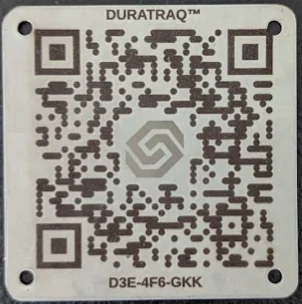
DuraTraq’s primary tag is laser-etched 316L stainless steel with Level H error correction, designed for a 10+ year service life in the harshest industrial conditions. Each tag undergoes a proprietary surface treatment that ensures reliable scanning across varied lighting conditions — direct sun, low light, artificial overheads — while preserving the passive corrosion-resistant layer of the base material.
Tags are verified to ISO/IEC 29158 (Direct Part Mark quality) and salt spray tested per ASTM B117. For curved surfaces where rigid tags aren’t practical, we offer UV-stabilized polyester label stock rated to 300°F.
Every tag links to a cloud-hosted asset profile — documentation, photos, maintenance history, and procedures — accessible from any smartphone with a single scan. No app download, no login for field access.
The tag is the product. The platform is what makes it valuable.